Coming Soon
One runtime. Three product forms.

The Swiss army knife
for CAN and K-Line.

A modular CAN and K-Line platform for OBD, simulation, diagnostics and tools — on the desktop, on a touch device, and in the wire.

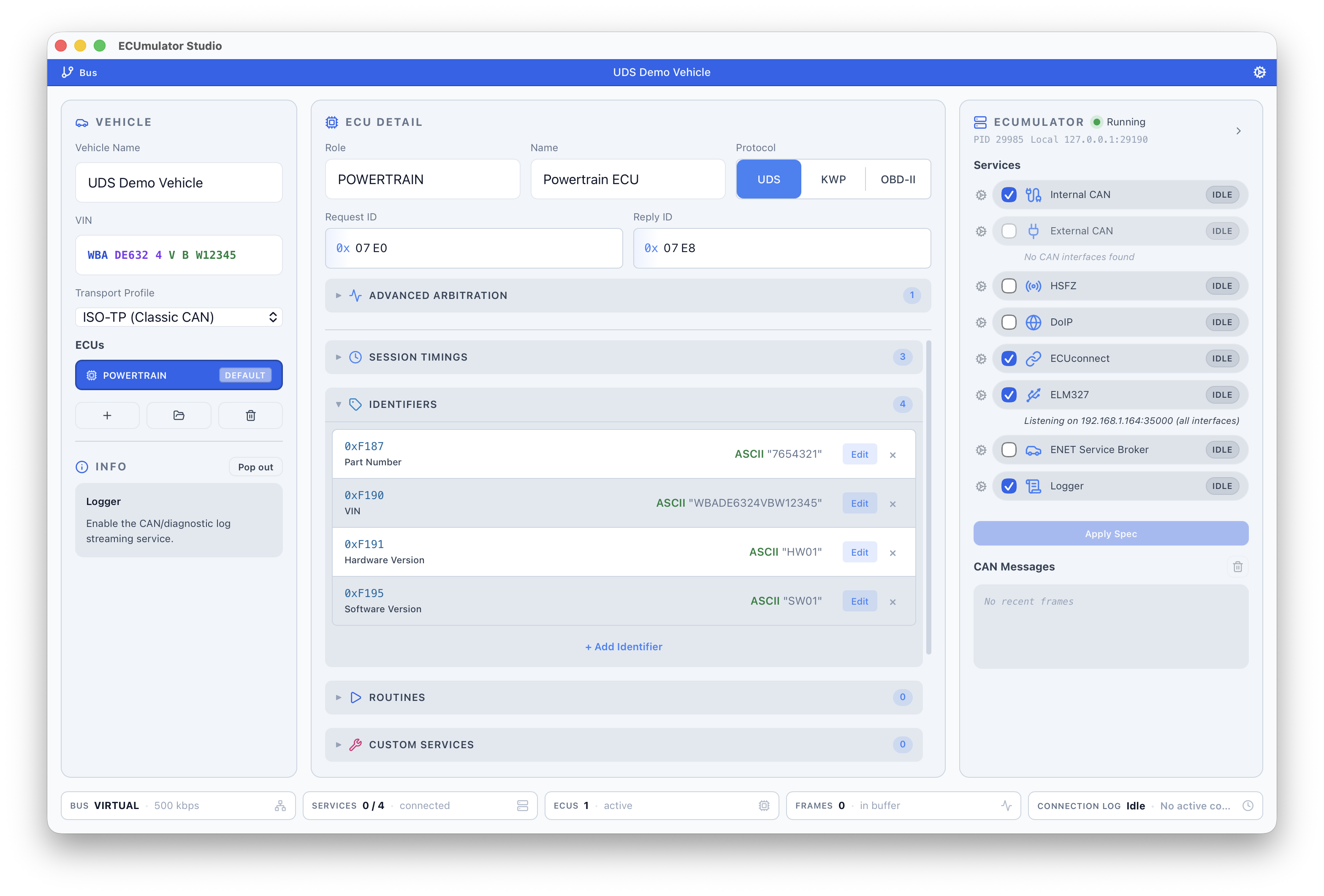
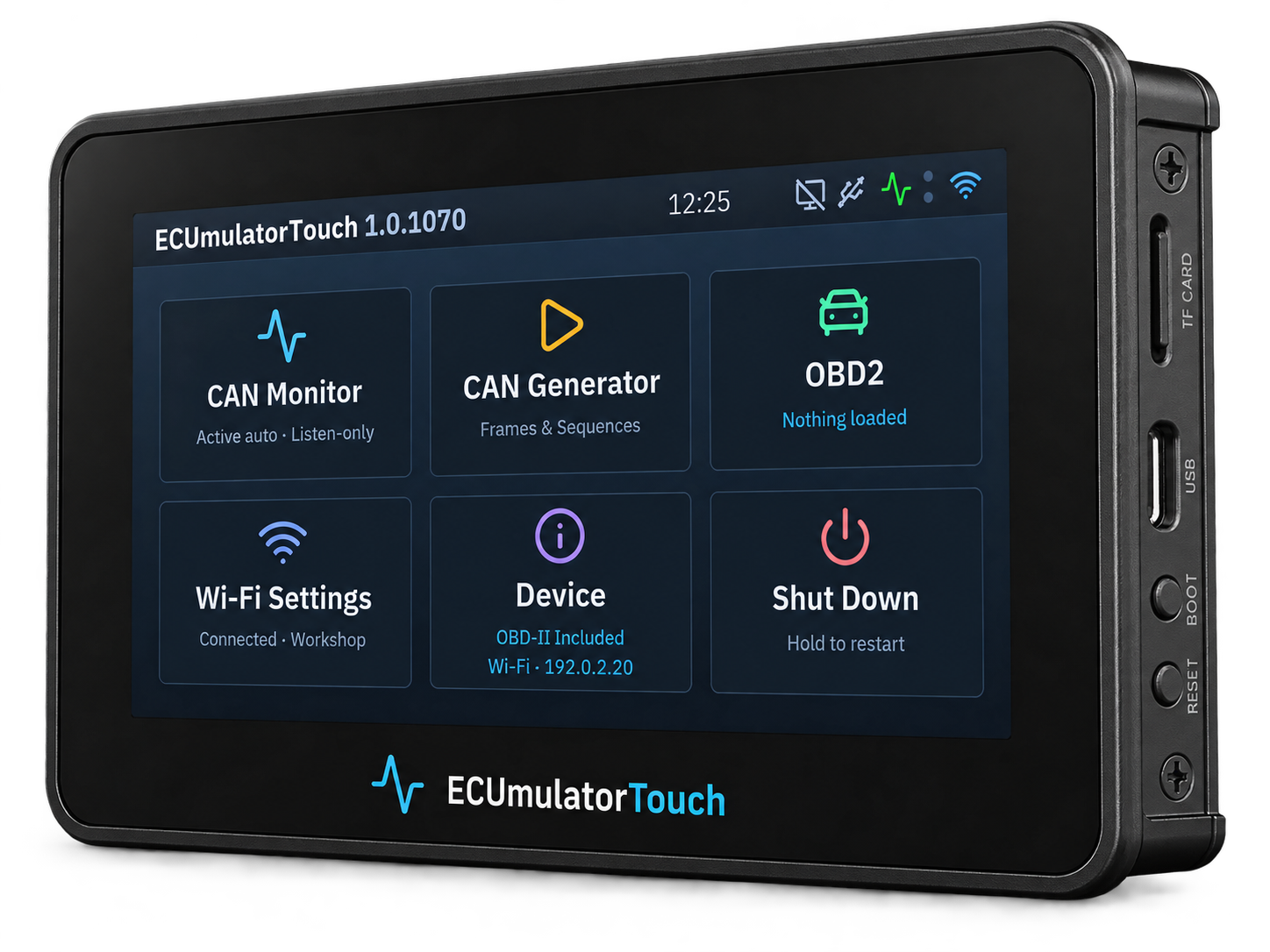
CANsole brings bus monitoring, OBD/UDS/KWP diagnostics, ECU simulation, logging, replay, test patterns and remote control into a single system. Studio runs on the desktop, Touch works standalone at the bench or in the vehicle, and ECUconnect turns a small adapter into a headless diagnostic node. All three share one runtime.

3
Product Forms
2
Bus Families
10+
Protocols Planned
1
Shared Runtime
Why CANsole

Between cheap dongles and enterprise restbus systems.

Most automotive bus tooling falls into one of two camps: low-cost OBD dongles that barely scratch the surface, or six-figure restbus simulation rigs that nobody outside a Tier‑1 lab can afford. CANsole sits in between — serious enough for development and reverse engineering, accessible enough for a single bench.

Active simulation, not just monitoring

Emulate ECUs and full restbuses, not only sniff the wire. Presets and bundles let you reproduce specific vehicle scenarios on demand.

Remote control by design

Every CANsole node speaks remote control from day one. Drive a Touch unit from Studio, automate ECUconnect from CI, or scope out a bench from your laptop.

One runtime, three surfaces

The same C++ core runs on macOS, Windows, Linux, ESP32 touch hardware, and ECUconnect adapters. UIs are control surfaces, not the runtime itself.

Reproducible tests

Preset-based scenarios, golden test sequences and replay turn ad-hoc bench work into something you can rerun next week and next year.

Standalone & networked

Touch boots into a known state and works without a host. Or join Wi-Fi/USB and become part of a larger setup. No lock-in either way.

Visible TX arming

Anything that can write to a real bus must be explicit, visible and loggable. No silent transmissions, no surprise frames.

What CANsole does

Three pillars on one runtime.

Watch the bus, talk to ECUs, simulate a vehicle. Each pillar is independently useful — together they cover the full development loop from passive observation to active testing.

Cockpit

Live monitoring & bus health

Look at the wire. Frame streams, decoded signals, error counters and timing — at the bench, in the vehicle, or remote.

  • Live frame stream with filter chains and triggers
  • Bus load, frame rate, error frames, REC/TEC, bus-off transitions
  • Per-ID cycle time, jitter and freshness tracking
  • DBC-decoded signal views, strip charts and gauges
  • K-Line line state, idle/break detection, byte trace
  • Logging with rotation, time-aligned multi-channel capture, replay
Diagnose

Talk to ECUs

Ask ECUs questions, read live data, walk diagnostic sessions and write changes — against a real bus or against the emulator.

  • OBD-II live PIDs, freeze frames, DTC read/clear, readiness, VIN/CAL-ID
  • UDS sessions, tester present, ECU reset and DTC services (0x19)
  • DID read/write (0x22 / 0x2E), RoutineControl (0x31), SecurityAccess
  • ISO-TP and ISO-TP/FD transport, multi-ECU address discovery
  • KWP, TP2.0 and ELM327/STN passthrough for legacy stacks
  • Diagnostic trace timeline — request/response pairs, not just frames
Emulate

ECU & restbus simulation

Stand up a controllable virtual vehicle. Build presets from real captures, replay scenarios, and reproduce specific bus conditions on demand.

  • Multi-ECU emulation with arbitration IDs, services and DIDs
  • Preset and bundle library, JSON-defined ECU specs
  • Spec import from candump, CL1000, ECUconnect and PCAPNG captures
  • Real-hardware bridge between virtual ECUs and a physical bus
  • SecurityAccess seed/key models, RoutineControl scenarios
  • Bus timing simulation, ISO-TP flow control fault injection
The Lineup

Three forms. One platform.

Studio, Touch and ECUconnect are not separate products that happen to share a logo. They are three control surfaces over the same diagnostic and simulation runtime. Pick the one that fits the workspace you are in.

Capability Map

Buses, protocols and tools.

What the platform speaks today, and where it is headed. Not every variant carries every capability — some are tied to specific hardware. Items shown dashed are planned.

Bus & Hardware

Classic CAN K-Line / ISO 9141 CAN‑FD ESP32 TWAI MCP251XFD OBD-II power

Diagnostic Protocols

OBD-II UDS KWP ISO-TP ISO-TP / FD TP2.0 ELM327 / STN ECUconnect TCP HSFZ DoIP ENET Service Broker

Tools

Bus monitor Frame sender Pattern generator Logging & export Replay Preset / bundle ECU sim DTC set / clear DID / PID models

Workflow

Remote control Standalone Status subscription SecurityAccess stubs RoutineControl Memory transfer Golden tests
In the Wild

Built for benches, rigs, and the road.

CANsole is shaped by real automotive workflows — the kind that happen between a developer’s desk, a workshop bench, and the OBD port of an actual car.

Protocol development

Bring up new diagnostic flows against a controllable virtual ECU before risking a real harness. Iterate on UDS sessions, security access and routine control without pulling a vehicle into the lab.

Reverse engineering

Capture a real bus, replay it under controlled conditions, and bisect responses until the message catalog falls into place. CAN, K-Line, and the transport layers on top.

Bench & workshop tests

Drop a Touch unit on a bench, pick a preset, and have a working restbus under one minute. No host required, no boot dance, no “wait, which COM port”.

CI & automation

ECUconnect nodes carry stable identities and TCP/UDP services. Wire them into a pipeline and run the same diagnostic regression on every pull request.

Bus health surveys

Track down a flickering wakeup, a noisy ID or a cycle-time drift. Cockpit views surface error frames, REC/TEC drift and per-ID jitter without manual capture spelunking.

DTC sweeps & ECU probes

Walk a UDS session against every ECU on the bus. Read DTCs, dump DIDs, capture VIN and software versions — scriptable from Studio or an ECUconnect node.

Available today

Two pillars already ship under sister brands.

CANsole is the convergence target. While the unified runtime is in active development, the live capabilities are already in production today as standalone desktop apps on vanille.de. They will fold into Studio over time.

Currently in active development.

CANsole is shaping up out of CAN Cockpit, ECUmulator, ECUconnect and ESPenlaub. If you build automotive tooling and want early access, the architecture page is the place to start.